

Cloud sovereignty explained for public safety
Police organisations, forensic science services and other public safety agencies manage sensitive information, from evidence and biometric data to scientific results and operational records. Choosing where their systems operate requires careful consideration of security, sovereignty, resilience, cost and operational control.
Deployment options range from on-premises infrastructure to customer-controlled, hybrid, sovereign and public cloud environments.
This guide explores these deployment models, explains the difference between data residency and sovereignty, addresses common misconceptions and provides a practical framework for evaluating options.
In this guide
What is cloud sovereignty?
Cloud sovereignty concerns the control an organisation retains over its information, infrastructure and operations, including the legal jurisdictions that apply.
Sovereignty is broader than data location. For public safety organisations managing evidential, forensic, personal or biometric information, it encompasses residency, jurisdiction, identity, encryption, governance, compliance, auditability and administrative control.
Further reading: Microsoft’s digital sovereignty guidance
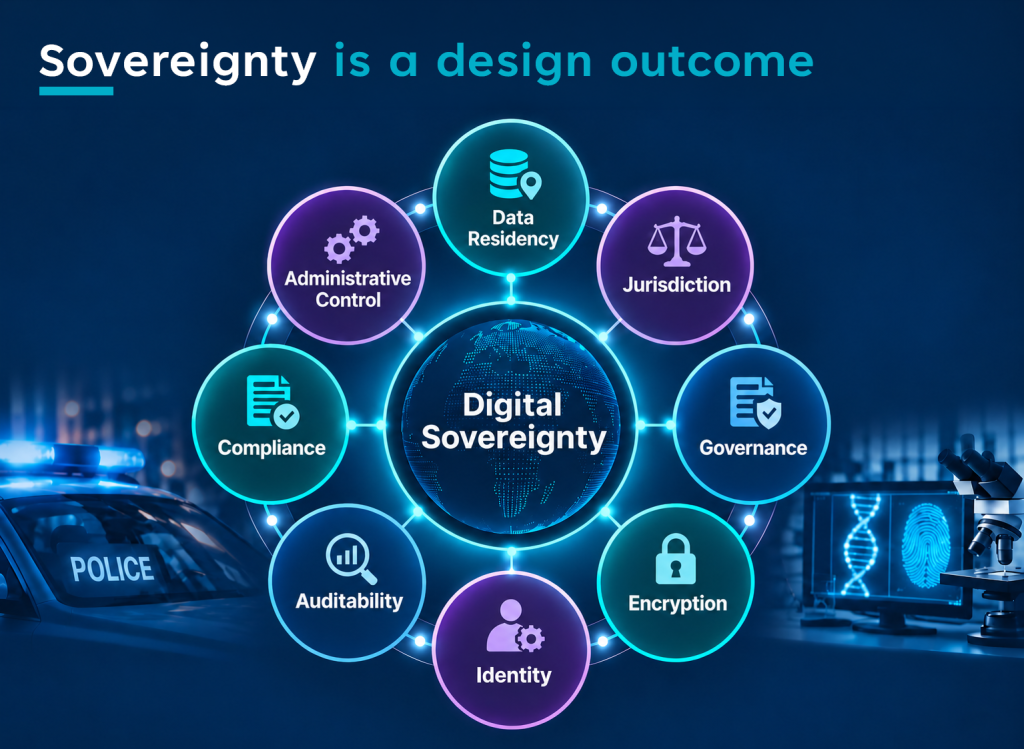
Where data sits is not the same as who controls it
Residency asks where
Data residency tells you where information is stored or processed. For forensic and evidential data, that location may be dictated by legal, contractual or policy requirements.
But location alone tells you little about who can access it.
Sovereignty asks who controls
Data sovereignty goes further. It considers who can access, administer and govern information, which laws apply and how those controls are enforced and audited.
Control depends on more than where the servers are located.
Data can remain within national borders and still be exposed through excessive access privileges, inadequate auditing or poorly managed encryption keys.
Understanding modern cloud deployment models
Public safety organisations can choose from several deployment approaches. The following models offer different benefits, responsibilities and trade-offs.
Microsoft, AWS and Google each document public-cloud, hybrid, local or sovereign options. Service scope, regional availability, operating models and contractual commitments differ and must be validated for the selected service and jurisdiction.
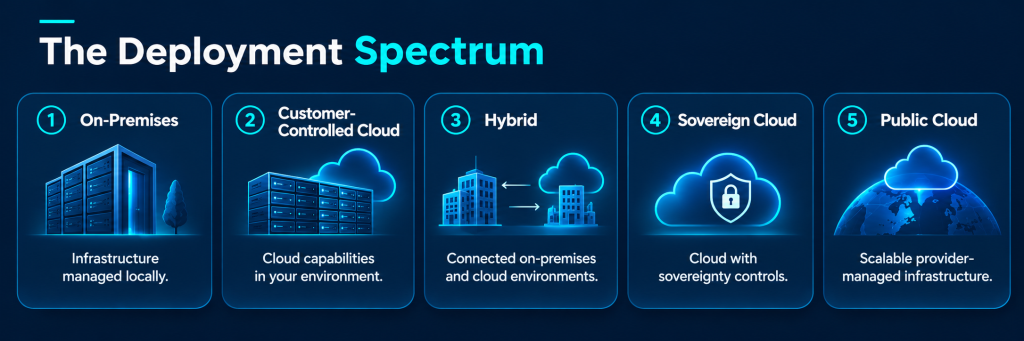
1) Traditional on-premises infrastructure
Infrastructure is owned or directly controlled by the organisation and operated in its facilities or an approved datacentre.
Benefits:
– Direct physical and network control
– Gapped operation
– Familiar ownership and change processes
Trade-offs:
– Capital investment and refresh cycles
– Responsible for availability, security and recovery
– Capacity and specialist skills must be maintained
Often suited to:
Police and forensic organisations operating highly sensitive systems that require direct infrastructure control, laboratories with equipment dependent on local networks, and facilities where reliable operation must continue without external connectivity. Also relevant where security policies or contractual requirements mandate locally controlled infrastructure.
2) Customer-controlled cloud
Cloud-consistent infrastructure is deployed in a customer-controlled or edge location.
Examples include Microsoft Azure Local, AWS Outposts and Google Distributed Cloud, though their capabilities and connectivity models are different.
Benefits:
– Local processing and data placement
– Cloud-consistent tooling for selected workloads
– Can support low-latency and some disconnected scenarios
Trade-offs:
– Hardware footprint and local facilities remain relevant
– Service catalogues are narrower than hyperscale public cloud
– Connectivity and operational responsibilities vary by offering
Often suited to:
Forensic laboratories and public safety organisations that need to keep selected workloads or data processing within their own facilities while using cloud-consistent technologies. Relevant for local analytics and AI processing, latency-sensitive applications, and organisations modernising existing infrastructure while retaining control over where workloads operate.
3) Hybrid cloud
Workloads and information services are placed across local, private and public environments according to need.
Benefits:
– Progressive modernisation
– Workloads can be placed by sensitivity, latency and capability
– Preserves existing investment
Trade-offs:
– More integration and governance complexity
– Consistent identity, monitoring and recovery require design
– Responsibility boundaries must be clear
Often suited to:
Police organisations and forensic science services operating a mix of legacy and modern systems, particularly where some applications or datasets must remain locally controlled while others can benefit from cloud services. Also relevant for organisations modernising in stages, integrating systems across multiple locations or managing workloads with different security and connectivity requirements.
4) Sovereign cloud
A sovereign operating model combines residency, jurisdictional, administrative, cryptographic and operational controls.
It may use public-cloud controls, dedicated or partner-operated infrastructure, or local and disconnected deployment.
Benefits:
– Access to cloud services within defined control boundaries
– Policy-based residency and administrative controls
– Multiple operating models are possible
Trade-offs:
– Sovereign is not a single standard product definition
– Controls and legal protections vary by provider and jurisdiction
– Potential restrictions in services, regions or operations
Often suited to:
Government agencies, police organisations and forensic science services handling sensitive or regulated information where specific requirements apply to data residency, legal jurisdiction, administrative access or encryption key control. Particularly relevant where organisations need cloud capabilities within clearly defined and verifiable sovereignty boundaries.
5) Public cloud
Shared hyperscale platforms deliver infrastructure and managed services from provider regions.
Benefits:
– Elastic capacity and broad service catalogues
– Rapid access to analytics and AI capabilities
– Resilience options across facilities and regions
Trade-offs:
– Requires disciplined governance and cost management
– Customer obligations remain under shared responsibility
– Service-specific residency and processing must be checked
Often suited to:
Public safety organisations requiring scalable infrastructure for digital services, collaboration, analytics or workloads with changing demand. Also relevant for organisations seeking access to managed services and advanced cloud capabilities, where the selected provider’s security, residency, compliance and operational controls meet their requirements.
The right deployment model starts with your requirements
The most suitable approach depends on your information, operational needs and governance obligations.
Start with the workload and the control it needs. Choose the deployment model second.
What is Azure Local?
Azure Local is Microsoft’s cloud-consistent infrastructure offering for customer-controlled locations. It runs supported workloads locally using selected Azure technologies and management capabilities.
For public safety organisations, it may be relevant where data placement, latency or operational requirements favour local infrastructure.
Service availability, connectivity and operational responsibilities must be validated for each deployment.
What does ringfenced mean?
A ringfenced sovereign cloud is not a separate deployment model. It describes technical, operational and contractual controls that establish an enforceable boundary across different infrastructure arrangements.
These may include approved regions, restricted network paths, access policies, authorised administrators, customer-controlled encryption keys, audit logging, contractual commitments and independent oversight.
Some offerings also support dedicated, partner-operated or disconnected infrastructure.
Start with questions you can verify
Use these prompts to make the required control boundary clear before selecting a platform.
- Where is each data category stored and processed?
- Who can administer the service?
- Which laws and contracts apply?
- Who controls encryption keys?
- What leaves the defined boundary?
- How is access evidenced?
- What happens during support, recovery and service failure?
Common misconceptions about cloud deployment
Is on-premises always the most secure option?
On-premises provides physical control, but the resulting security depends on investment, architecture, patching, monitoring, identity, backup, recovery and staff capability.
NIST zero trust guidance moves security away from implicit trust based on physical or network location.
Can sovereignty only be achieved on-premises?
Sovereignty may be achieved using combinations of public-cloud controls, sovereign public cloud, partner-operated environments, customer-controlled cloud or disconnected infrastructure.
The required outcome and evidence should determine the model.
Does AI mean losing control of where data is sent?
AI can be deployed across public, sovereign, local and disconnected environments.
The risk depends on the chosen service, model, configuration, data flow, retention terms and governance.
For example, Google documents AI capabilities within its Distributed cloud air-gapped environment.
Does secure analysis require organisations to share raw data?
Privacy-preserving architectures can execute approved workloads against protected information and release controlled outputs.
Confidential computing and related approaches can reduce particular exposure paths. Legal authority, data minimisation, output controls and re-identification risk still require consideration.
Is cloud inherently expensive?
Cloud cost is an operating outcome. Elastic capacity and managed services can reduce overprovisioning and operational effort, while unmanaged consumption, data movement and duplicated services can increase cost.
Cost modelling should compare the full lifecycle, including people, facilities, resilience, refresh and exit.
Is multi-tenancy inherently insecure?
Effective multi-tenancy requires well-designed identity, authorisation, isolation, encryption, logging and verification. The UK National Cyber Security Centre includes separation between customers among its cloud security principles.
Shared infrastructure does not automatically mean shared access.
How to choose the right deployment model
A balanced deployment decision should begin with requirements and evidence, rather than a preferred technology label. The following eight-step framework helps public safety organisations assess their options.
1
Classify the information
Identify evidential, personal, biometric, scientific, operational and public information. Set residency, retention, privilege and disclosure constraints.
2
Define sovereignty outcomes
Specify geographic, legal, administrative, cryptographic, continuity and supplier-control requirements.
3
Map workload needs
Assess latency, connectivity, scale, resilience, integration, analytics and AI needs.
4
Allocate responsibilities
Define responsibilities across the organisation, solution provider, cloud provider and partners for prevention, detection, response and recovery.
5
Evaluate deployment options
Compare on-premises, customer-controlled cloud, hybrid, sovereign and public cloud against common requirements and full lifecycle costs.
6
Validate claims
Verify service-specific documentation, contracts, data flows, certifications, architecture and operational procedures.
7
Design for evolution
Prioritise modular interfaces, portability, observable integrations and data models that support controlled growth.
8
Measure outcomes
Track security, reliability, cost, quality, adoption, workload and decision outcomes beyond initial deployment.
How bdna supports flexible deployment
The right deployment strategy depends on an organisation’s operational needs, security requirements and the level of control it must retain over sensitive information. For police organisations and forensic science services, this may involve combining different deployment models rather than relying on a single approach.
Bdna works with police organisations and forensic science services to deliver its Public Safety Platform in environments that align with their operational, security and data sovereignty requirements. Our approach supports cloud, on-premises and hybrid deployment models, including options such as Microsoft Azure and customer-controlled infrastructure, including Azure Local.
We help organisations assess deployment considerations such as data residency, infrastructure control, security, integration and operational continuity, supporting an approach suited to their environment.
GET STARTED
Ready to modernise your forensic and investigative workflows?