

Choosing modern forensic software
A practical buyer’s guide for police agencies, forensic science services and crime laboratories
Modern policing and forensic science depend on timely, accurate, secure and trusted information.
Police organisations, forensic science services and crime laboratories use technology to support evidence collection, submission, exhibit management, forensic examination, identification, reporting and investigations. Over time, many organisations have implemented separate systems to support these individual activities.
These include Laboratory Information Management Systems (LIMS), evidence and exhibit management systems, digital evidence platforms, biometric identification systems, investigation management solutions, and systems for equipment, training, certification and quality management.
Each system may perform its individual role effectively. However, systems do not always work together as efficiently as organisations require.
As information moves between operational teams, disconnected systems can create:
- Duplicate data entry
- Manual handovers
- Delays in evidence processing
- Limited visibility of case progress
- Inconsistent or incomplete information
- Increased administrative effort
- Difficulty sharing and accessing information across systems
- Greater risk of errors or lost context
Selecting modern forensic software means evaluating how technology supports the management and movement of forensic information across policing, forensic science and the justice process.
This guide explores four design principles, the operational benefits they deliver and the questions organisations should ask when evaluating forensic software.
Start with the forensic process
Software should support the forensic process as a whole, rather than simply automating individual operational activities.
Every investigation follows an operational journey. Requests for service are submitted and received, evidence is collected, submitted, stored, examined, interpreted and ultimately presented to investigators and the courts. At every stage, information must remain accurate, secure, traceable and available to authorised users.
Each stage generates information that may be required by another team later in the process. The more effectively this information moves with the evidence, the less effort is required to recreate context or re-enter data.
Many inefficiencies occur at the points where information moves between operational teams. These handover points can create delays, duplicate work and information loss even when the individual systems involved are working as designed.
Modern forensic software should reduce these leakage points by supporting the continuous movement of information while maintaining quality, security and evidential integrity.
Modern forensic software should not be evaluated solely on what it does within one application. It should be evaluated on how well it supports the movement of forensic information across the entire forensic process.
Why organisations review forensic software
Technology replacement projects are rarely driven by software alone. They usually begin because operational requirements have changed.
Common drivers include:
- Increasing evidence volumes
- Growth in digital evidence
- Ageing or unsupported systems
- Duplicate data entry across multiple applications
- Limited visibility across policing, forensic and investigative workflows
- Changing accreditation, governance or security requirements
- Organisational growth or restructuring
- The need to improve collaboration between operational teams
- The increased demand for reporting and operational intelligence
- Pressure to improve turnaround times and service quality
- Increasing workloads without corresponding increases in staffing
Many organisations initially set out to replace a LIMS, an evidence management system or another individual application.
During planning, organisations may discover that replacing one system alone will not resolve inefficiencies across the wider forensic process. Reviewing the end-to-end process can reveal opportunities to improve efficiency, information management and collaboration across teams.
For example, a new laboratory system may improve laboratory workflows but leave evidence submission, exhibit storage and communication processes unchanged. The organisation may still experience delays and duplicate data entry at the boundaries between systems.
This changes the questions organisations should ask.
Instead of asking only which system has the most features, organisations should ask:
Does your current technology support the way you want to operate in the future?
Four principles to consider when choosing modern forensic software
Modern forensic software should do more than record laboratory activities or replace individual systems. It should strengthen how forensic information is created, managed and used throughout policing, forensic science and the justice process.
Understanding these principles helps organisations look beyond feature lists and evaluate whether a solution will continue to deliver value as operational requirements evolve.
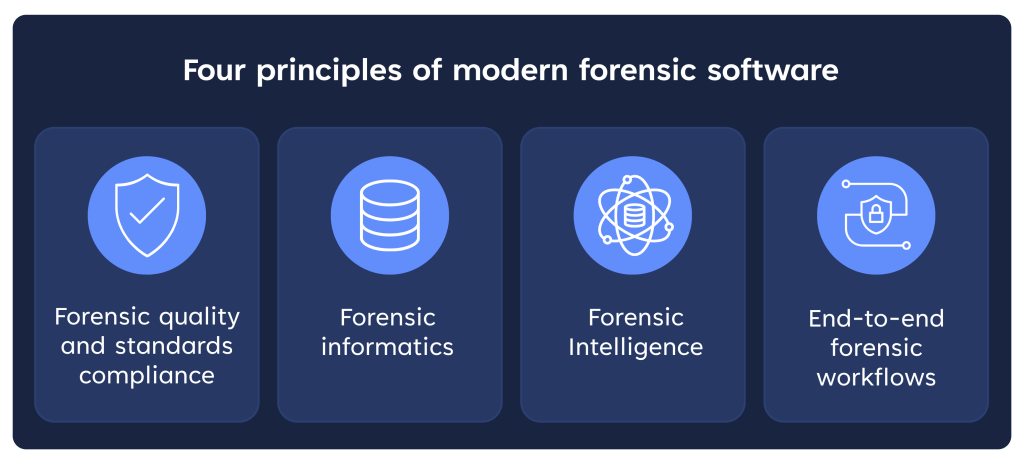
1) Forensic quality and compliance
Why it matters
Confidence in forensic outcomes depends on more than scientific expertise. It also depends on consistent, repeatable and auditable processes.
Modern forensic software should fully incorporate recognised forensic standards Including quality management, technical review, evidential integrity and chain of custody within everyday operational workflows.
When quality processes are embedded in workflows, organisations can improve consistency, maintain compliance, reduce administrative effort and dedicate more time delivering forensic services.
What to look for
Look for software that supports:
- Forensic quality standards including ISO/IEC 17025 and 21043
- Configurable technical review and authorisation workflows
- Complete and searchable audit history
- Secure chain of custody records
- Configurable quality controls
- Role-based permissions and approvals
- Traceability from evidence submission through to reporting
- Controlled management of changes, corrections and rework
- Retention of relevant records and supporting documentation
- Automated report and statement generation
Organisations should distinguish between software that supports compliance activities and a vendor or laboratory that holds a particular certification or accreditation. These are not interchangeable claims and should be verified during procurement.
2) Forensic informatics
Why it matters
Every stage of the forensic process generates valuable operational information. Its value depends on how easily it can be captured, searched, shared and reused. In many environments, information is duplicated across multiple systems, spreadsheets and reports. Different teams often maintain separate versions of the same information, increasing administrative effort and reducing confidence in operational data.
Forensic informatics focuses on treating forensic information as an organisational asset rather than simply recording laboratory activity.
When information is structured consistently and shared appropriately, organisations gain:
- better visibility of operational workloads
- more reliable reporting
- faster access to relevant case information
- reduced duplication
- informed decision making
- improved opportunities for analysis and intelligence
What to look for
Look for software that:
- Captures information once and reuses it throughout the workflow
- Supports structured and searchable information
- Maintains relationships between cases, exhibits, samples, examinations and reports
- Integrates with existing police, forensic and justice systems
- Supports open APIs or other interoperability options
- Reduces duplicate data entry
- Provides meaningful operational reporting and analytics
- Allows authorised information to be shared without weakening access controls
3) Forensic intelligence
Why it matters
The value of forensic information extends beyond laboratory reporting.
Forensic information should help investigators understand what has happened, identify links between cases and make informed operational decisions while investigations are still active.
When forensic information remains isolated within individual systems or becomes available too late, opportunities to generate investigative value may be missed.
Modern forensic case management software should make relevant information available to authorised users when it can have the greatest operational impact.
What to look for
Look for software that:
- Supports collaboration between police and forensic teams
- Provides timely access to examination status and results
- Connects forensic information with investigative workflows
- Supports operational reporting
- Helps identify relationships between relevant cases or exhibits where appropriate
- Provides role-based access to sensitive information
- Records how information is accessed, shared or changed
- Supports information sharing without compromising privacy, security or evidential integrity
Forensic intelligence should not mean unrestricted access to sensitive information. Effective systems provide useful access to the right people for the right purpose.
4) End-to-end forensic workflow
Why it matters
Every movement or examination of evidence generates information that must remain connected to the evidence throughout its lifecycle.
From crime scene attendance and collection through evidence submission, exhibit management, laboratory examination, reporting and investigation, information can pass between multiple people, places, systems and even organisations.
Maintaining a consistent identifier throughout this journey is an important part of evidence continuity. Where evidence is renumbered or relabelled as it moves between teams, systems or organisations, additional effort may be required to demonstrate that each record refers to the same item. A single identifier from scene to courtroom helps preserve that connection, reducing unnecessary relabelling and supporting a clear, traceable evidence history.
Each handover creates an opportunity for:
- delays
- duplicate effort
- missing information
- incorrect transcription
- unclear ownership
- reduced visibility
- breaks in continuity.
The objective is not simply to digitise existing processes. It is to ensure that information remains connected throughout the forensic process, reducing administrative effort while improving visibility and evidential integrity.
What to look for
Look for software that:
- Supports connected workflows across operational teams
- Maintains evidence continuity throughout the evidence lifecycle
- Supports a persistent identifier for evidence from scene to courtroom
- Reduces manual handovers and duplicate data entry
- Supports mobile evidence submission and field operations
- Provides visibility of status, ownership and next steps
- Enables secure online and offline working where operationally required
- Scales across locations, multiple forensic disciplines and operational environments
Questions to ask before selecting forensic software
Feature lists rarely tell the whole story.
Use these questions during supplier demonstrations, requirements workshops and procurement discussions to understand how each solution would support your organisation’s operational needs:
- How does the solution support information movement from evidence submission through investigation?
- Which handover points does it remove or simplify?
- How are tasks, ownership and status managed?
- Can the system support the complete evidence lifecycle?
- What information is entered once and reused later?
- How are cases, exhibits, samples, examinations, images and reports connected?
- What search and reporting capabilities are available?
- How does the platform integrate with existing systems?
- Are APIs and integration documentation available?
- How are data quality, retention and migration managed?
- How are quality processes, technical review and authorisation supported?
- How is chain of custody recorded?
- Can the organisation configure its own controls and approval stages?
- How is the audit history protected and reviewed?
- What evidence can the supplier provide for relevant compliance claims?
- How is relevant forensic information made available to investigators?
- What dashboards and operational reports are included?
- Can authorised users monitor workload, turnaround times and outstanding actions?
- Can information be analysed across teams, disciplines or locations?
- How are privacy and access controls applied?
- What hosting and deployment models are available?
- Where is data stored?
- How are identity, authentication and access managed?
- Is encryption used in transit and at rest?
- What backup, disaster recovery and business continuity arrangements are available?
- How are security events and administrative actions recorded?
- Can workflows evolve without major redevelopment?
- Can the platform support additional forensic disciplines?
- Can the organisation adopt products incrementally?
- How are upgrades delivered and managed?
- What is the supplier’s product roadmap?
- Can the solution support organisational growth and restructuring?
How the bdna Public Safety Platform applies these principles
The bdna Public Safety Platform supports the complete forensic information journey, from crime scene and evidence submission through exhibit management, forensic examination, investigation and court outcomes.
A shared design philosophy connects Forensics, Exhibits and Portal. Together, these products create a connected operational environment where forensic information can be captured once, managed securely, reused throughout the workflow and made available to authorised users when needed.
The platform applies four core design principles:
- Forensic quality and standards compliance.
- Forensic informatics.
- Forensic intelligence.
- Connected end-to-end forensic workflows.
These principles underpin how bdna supports the creation, management and sharing of forensic information across policing, forensic science and the justice process.
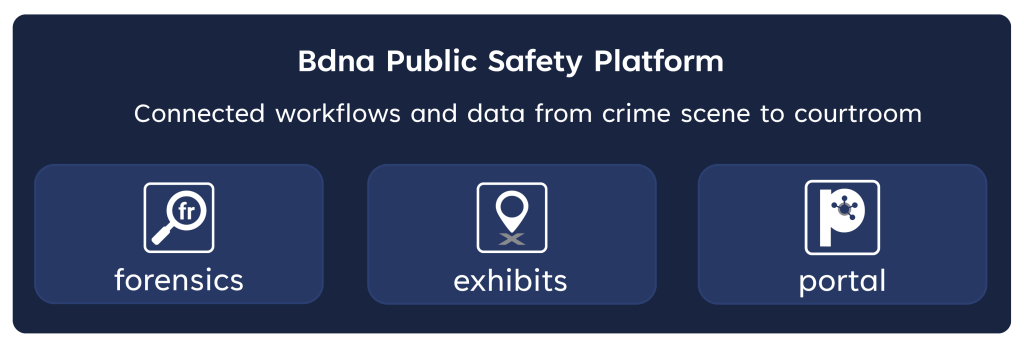
Forensics
The forensic-register provides end-to-end forensic case and laboratory management.
It supports the management of forensic work from collection, submission and triage through examination, review, authorisation, reporting and investigation. ISO-aligned workflows, configurable quality controls, audit history, chain-of-custody information and role-based processes help organisations maintain consistency, traceability and evidential integrity throughout forensic operations.
A single identifier can follow evidence from scene to courtroom, maintaining a consistent reference as it moves through collection, submission, examination, reporting and court processes. This reduces the need for renumbering or relabelling between stages and strengthens continuity and traceability across the evidence lifecycle.
The forensic-register provides the operational visibility required to manage cases, workloads, examinations and outcomes across forensic teams and disciplines. Mobile evidence capture and connected workflows help ensure that information collected in the field remains available throughout subsequent forensic activity.
By connecting case, evidence, examination and reporting information, Forensics helps organisations:
- Manage the complete forensic case lifecycle
- Maintain traceability from submission to report
- Maintain a consistent evidence identifier from scene to courtroom
- Support quality management and technical review
- Preserve evidence continuity and chain of custody
- Capture and reuse information throughout the workflow
- Provide authorised users with timely access to case and examination information
- Monitor workloads, progress and operational performance
- Support collaboration between forensic practitioners, investigators and other operational teams.
Exhibits
Exhibits supports the operational management of property and exhibits held in police custody.
It extends beyond traditional property management by helping organisations maintain continuity, accountability and visibility throughout the exhibit lifecycle. From receipt and storage through movement, examination, return or disposal, information remains connected to the relevant exhibit and available to authorised users.
Applying the same design principles as the wider platform, Exhibits helps reduce manual handovers and administrative effort while strengthening control over property and evidence. Its operational information supports both property managers and investigators, helping them understand where exhibits are, what actions are outstanding and how exhibits relate to wider investigative activity.
Exhibits helps organisations:
- Manage property and exhibits throughout their lifecycle.
- Maintain secure and auditable records of exhibit custody and movement.
- Support chain-of-custody and evidential-integrity requirements.
- Improve visibility of exhibit location, status and ownership.
- Reduce manual processing and duplicate data entry.
- Connect exhibit information with forensic and investigative workflows.
- Support operational reporting and management oversight.
- Provide authorised users with timely access to relevant exhibit information.
Portal
Portal supports evidence submission, forensic triage and collaboration between frontline police and forensic services.
It enables information to be captured at the point of submission and carried forward into subsequent forensic workflows. This helps improve the completeness and quality of submissions, reduces re-keying and gives forensic teams the information they need to assess, prioritise and progress work.
Portal connects submitting officers and frontline teams with forensic services through a structured, secure and visible process. Rather than relying on disconnected forms, emails or manual handovers, organisations can manage submission information, communication, triage decisions and progress within a connected operational environment.
Portal helps organisations:
- Capture evidence and case information at the point of submission
- Support structured digital evidence submission
- Improve the quality and completeness of submitted information
- Enable forensic triage and prioritisation
- Support communication between police and forensic teams
- Reduce duplicate data entry and manual handovers
- Provide visibility of submission status and next actions
- Ensure information remains connected to subsequent forensic workflows
- Support secure collaboration between authorised users
- Keep investigators up to date with access to forensic results in real time as they are published.
One connected platform
Forensics, exhibits and portal address different operational requirements, but they are built on the same underlying principles.
Together, they enable organisations to connect:
- Frontline evidence submission
- Forensic triage
- Property and exhibit management
- Laboratory case management
- Examination and technical review
- Reporting and authorisation
- Investigation and operational intelligence
- Evidence continuity and court preparation.
This connected approach helps organisations manage forensic information as a continuous operational asset rather than separate records held in isolated applications.
Information can be captured at the earliest appropriate point, maintained throughout the evidence lifecycle and made available to authorised users across the process. Consistent identifiers help preserve the connection between evidence and its information from scene to courtroom, while connected workflows reduce leakage points between teams, improves operational visibility and supports stronger evidential integrity.
The principles discussed in this guide align with broader thinking across the forensic science community. If you’d like to explore these topics in more detail, the following publications provide valuable additional context:
- National Institute of Forensic Science (Australia): End-to-End Forensic Identification Process Project – Phase 2 Final Report (2016)
- Forensic Technology Center of Excellence (US): Laboratory Information Management Systems in Forensic Science Service Provider Laboratories: Current State and Next Generation (2024)
GET STARTED
Ready to modernise your forensic and investigative workflows?