

Forensic Investigative Genetic Genealogy: From DNA to investigative lead
Forensic science continues to provide investigators with new ways to generate leads in complex criminal investigations. One of the most significant developments in recent years is Forensic Investigative Genetic Genealogy (FIGG), a technique that combines forensic DNA analysis with genetic genealogy to identify potential suspects through biological relatives.
Internationally, FIGG has helped investigators generate leads in cases that had remained unsolved for decades, including the identification of the Golden State Killer in the United States. It is being adopted in a growing number of jurisdictions for carefully selected investigations involving offences such as homicide, sexual assault and the identification of unknown human remains.
Every genealogical lead generated through FIGG creates new forensic information that must be documented, linked to the case and managed alongside laboratory activities throughout the life of the investigation.
Forensic case management and forensic informatics help preserve those relationships and maintain context, supporting quality management and evidence continuity while enabling forensic organisations to confidently integrate new scientific capabilities into established workflows.
Understanding FIGG
Traditional forensic DNA profiling compares a DNA profile recovered from a crime scene with a known reference sample.
Standard forensic DNA profiling analyses a defined set of genetic markers that distinguish one individual from another. When investigators obtain a suitable reference sample from a suspect or person of interest, the comparison can include or exclude that individual.
FIGG is typically used as a last resort in investigations where conventional methods, including standard forensic DNA database searches, have been exhausted without identifying a person of interest. It provides another avenue for generating investigative leads by identifying potential biological relatives of the unknown individual.
To do this, FIGG analyses hundreds of thousands of single nucleotide polymorphisms (SNPs) across the genome. These markers are commonly used by consumer genetic genealogy databases because they reveal biological relationships between individuals.
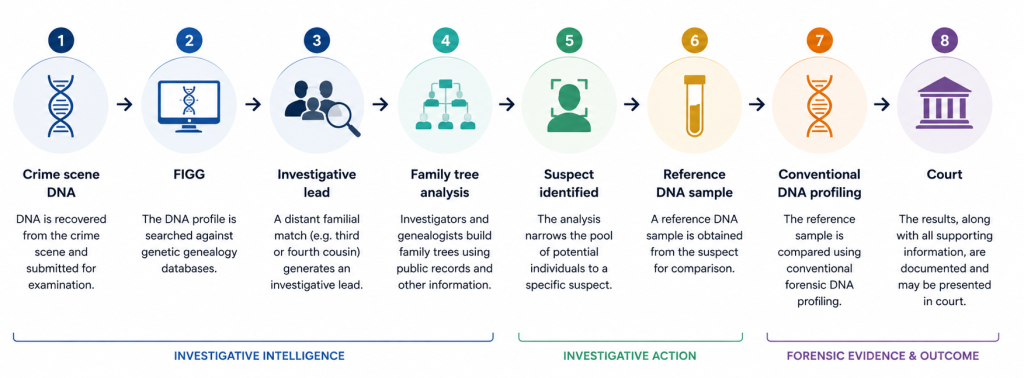
If a biological relative of the unknown individual has voluntarily uploaded their DNA to a participating database and opted in to law enforcement searches, investigators may identify a distant familial relationship, such as a third or fourth cousin.
This familial relationship becomes an investigative lead that investigators can pursue using conventional investigative techniques.
Investigators and forensic genealogists combine the genetic information with family history, public records and conventional investigative techniques to construct family trees and progressively narrow the pool of potential individuals.
Once investigators identify a potential suspect, they obtain a new reference DNA sample and undertake conventional forensic DNA profiling. That comparison provides the evidentiary basis to include or exclude the individual.
FIGG also depends on the availability of a suitable DNA sample and the requirements of the relevant jurisdiction. Depending on the jurisdiction, FIGG may be limited to serious offences and subject to formal approval and governance processes.
How FIGG fits into the forensic workflow
FIGG generates investigative leads that become part of the managed forensic record. Every stage creates information that should remain connected, traceable and governed throughout the life of the investigation.
Managing forensic information
FIGG illustrates a broader trend in forensic science: as scientific capabilities evolve, so too does the volume and complexity of forensic information that must be managed. Once a genealogical lead results in further forensic activity, the resulting information needs to remain connected with the relevant submissions, exhibits, laboratory requests, examinations, results and final authorised report.
A single investigation may involve multiple evidence types, laboratory disciplines, investigators and external agencies, all contributing information at different stages of the case.
Forensic informatics provides the framework for managing those relationships. Rather than treating each activity as a separate process, it ensures that information remains connected throughout the forensic workflow, preserving the context needed to support scientific interpretation, operational decision making and judicial outcomes.
Information captured once can be securely shared, reused and traced throughout the life of the case, reducing duplication while improving consistency and data quality.
For organisations operating under standards such as ISO/IEC 17025, maintaining complete, traceable records is fundamental to demonstrating quality, transparency and confidence in forensic outcomes. As new techniques such as FIGG become part of operational practice, those same principles help ensure that scientific innovation strengthens, rather than complicates, established forensic workflows.
Supporting forensic practice with modern connected case management
Modern forensic case management connects the evidence, people, information and processes involved in a case, providing a complete and traceable record from the initial submission through to reporting and court.
At bdna, these principles underpin the design of the bdna forensic-register. It supports the secure management of submissions, exhibits, examinations, laboratory workflows, reporting and forensic intelligence within a single forensic information environment.
Rather than managing information as isolated records, our forensic case management software preserves the relationships between evidence, scientific examinations and their results. This enables laboratories and forensic organisations to maintain context throughout the life of a case while supporting quality management, auditability and evidence continuity.
This single source of truth also supports collaboration between frontline investigators, forensic scientists and laboratory staff. Organisations can reduce duplication, improve visibility across the forensic workflow and ensure that critical information is available to the right people at the right time.
Conclusion
Scientific innovation continues to expand what is possible in forensic investigations. Techniques such as Forensic Investigative Genetic Genealogy provide investigators with powerful new ways to generate leads in cases that once appeared unsolvable.
Realising the full value of these advances, however, depends on more than the science itself.
Every new technique generates information that must be managed with the same discipline as every other part of the forensic process. Forensic informatics and connected case management enable forensic organisations to integrate emerging scientific capabilities while preserving governance, evidence continuity and confidence in forensic outcomes.